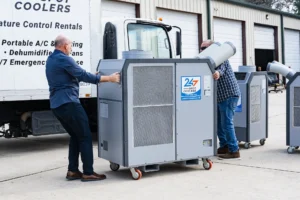
When a space overheats, production slows, equipment fails, or employees become uncomfortable. Whether you are cooling a server room, supplementing an underperforming HVAC system, or responding to an emergency, choosing the right portable cooling unit is critical. Incorrect spot cooler sizing can leave you short on cooling power or paying for more capacity than you actually need.
This guide explains how to determine the correct capacity using BTUs, tons, heat load calculations, and real-world room conditions so you can confidently answer the question: how many tons ac do I need?
Understanding BTUs and Tons of Cooling
Before diving into calculations, it helps to understand the basic measurements.
BTU (British Thermal Unit)
A BTU measures the amount of heat required to raise the temperature of one pound of water by one degree Fahrenheit. In cooling terms, it represents how much heat an air conditioner can remove per hour.
Tons of Cooling
One ton of cooling equals 12,000 BTUs per hour. The term comes from the amount of heat needed to melt one ton of ice in 24 hours.
Quick reference:
- 1 ton = 12,000 BTU/hr
- 2 tons = 24,000 BTU/hr
- 5 tons = 60,000 BTU/hr
If you are comparing equipment options or trying to determine commercial portable ac size, always convert everything to BTUs so you can compare capacity accurately.
Step 1: Measure the Space
Start with the basic room dimensions:
- Length (feet)
- Width (feet)
- Ceiling height (feet)
Multiply these together to determine cubic footage:
Length × Width × Height = Cubic Feet
For example:
20 ft × 30 ft × 10 ft = 6,000 cubic feet
This number gives you a baseline for calculate btu cooling needs.
Step 2: Estimate Base Cooling Load
A simple starting rule for general spaces is:
20 to 30 BTUs per square foot for light-duty cooling
Using square footage:
20 ft × 30 ft = 600 square feet
600 sq ft × 25 BTU (average) = 15,000 BTU/hr
That equals approximately 1.25 tons of cooling.
However, this is only a starting point. Real-world applications require factoring in heat load.
Step 3: Account for Heat Load
Heat load is the total amount of heat generated inside the space. In commercial and industrial settings, this often matters more than room size.
1. People
Each person generates roughly:
- 400 to 600 BTU/hr (depending on activity level)
If 5 people regularly occupy the space:
5 × 500 BTU = 2,500 BTU/hr
2. Equipment
Office and industrial equipment generate significant heat:
- Desktop computer: 300 to 500 BTU/hr
- Server rack: 3,000 to 10,000+ BTU/hr
- Industrial machinery: varies widely
Always check manufacturer specifications when possible.
3. Lighting
Lighting can add:
- 3 to 5 watts per square foot
- Convert watts to BTU by multiplying watts × 3.41
Example:
1,000 watts × 3.41 = 3,410 BTU/hr
4. Sun Exposure
Rooms with direct sunlight, large windows, or poor insulation can significantly increase cooling demand. South- and west-facing walls typically add the most heat.
Add 10 to 20 percent to your total BTU requirement for high solar load conditions.
Step 4: Add It All Together
To determine spot cooler sizing, combine:
- Base room BTU requirement
- People heat load
- Equipment heat load
- Lighting heat load
- Solar gain adjustment
Example total:
- Base cooling: 15,000 BTU
- People: 2,500 BTU
- Equipment: 8,000 BTU
- Lighting: 3,410 BTU
Total = 28,910 BTU/hr
Divide by 12,000:
28,910 ÷ 12,000 ≈ 2.4 tons
In this case, you would likely choose a 2.5-ton or 3-ton unit to ensure sufficient capacity.
Spot Cooling vs. Room Cooling
It is important to distinguish between cooling an entire room and cooling a specific area.
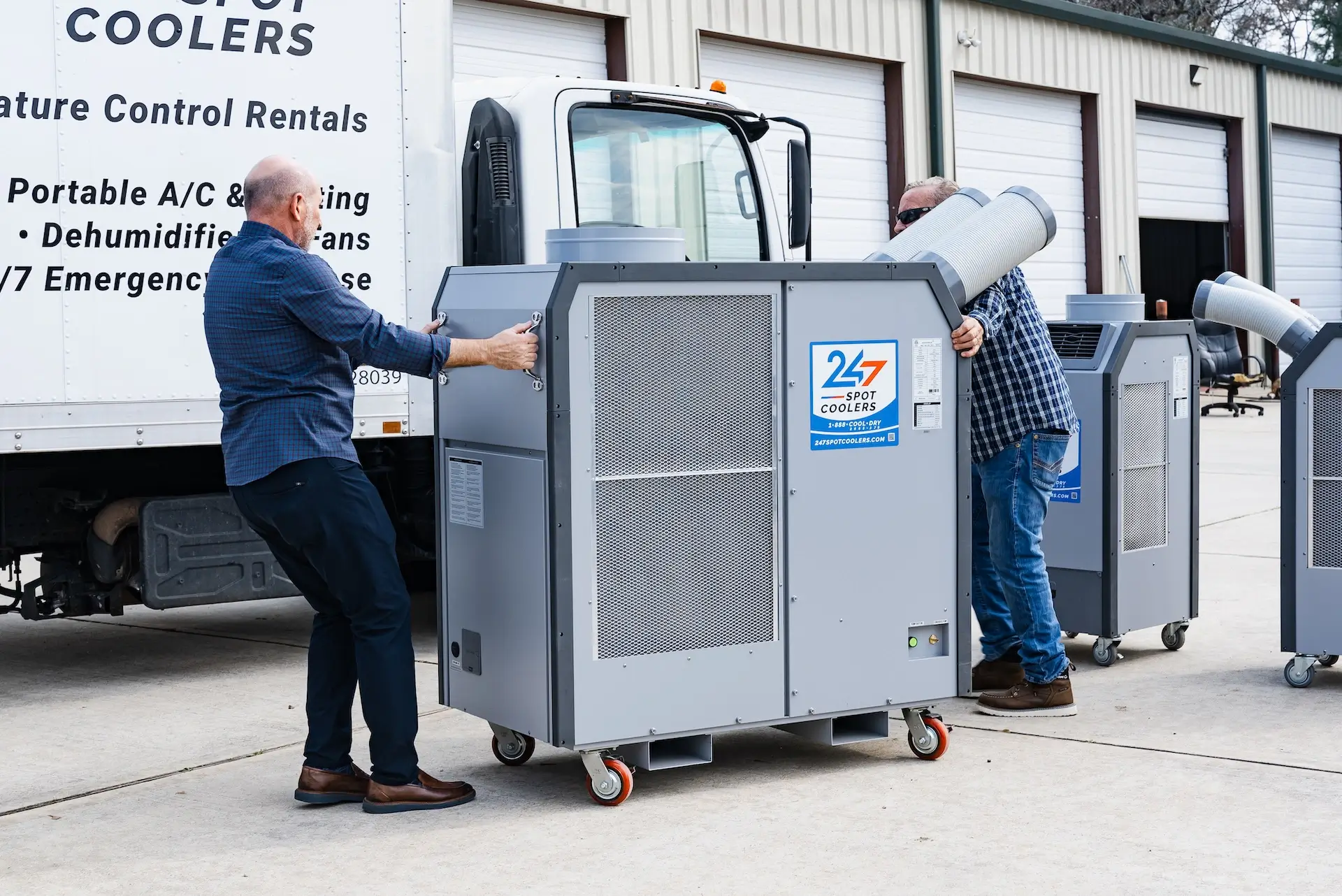
Spot coolers are designed to:
- Direct cool air to a specific workstation or machine
- Reduce temperature in localized zones
- Provide temporary or emergency cooling
If you are only cooling a single piece of equipment or a workstation, you may not need to size for the entire room volume. Instead, focus on the specific heat source.
This approach often reduces the required commercial portable ac size significantly.
Environmental Factors That Affect Sizing
Room conditions can dramatically impact performance.
Ceiling Height
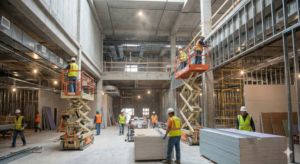
Higher ceilings increase air volume and heat accumulation. Large warehouse spaces often require higher-tonnage units or multiple units.
Air Changes and Ventilation
If doors are frequently opened or if the space has significant air exchange, cooling loads increase.
Insulation Quality
Poor insulation means more heat infiltration. Well-insulated rooms require less cooling capacity.
Ambient Temperature
If the unit operates in extreme heat, such as 95°F to 110°F conditions, performance may drop slightly. Always verify manufacturer performance data under high ambient conditions.
What Happens If You Undersize or Oversize?
Undersized Unit
- Runs continuously
- Fails to reach desired temperature
- Shortens equipment lifespan
- Creates humidity control problems
Oversized Unit
- Higher upfront cost
- Excess energy consumption
- Short cycling in smaller spaces
Proper spot cooler sizing ensures balanced performance and efficiency.
Quick Sizing Reference Chart
While detailed calculations are best, here is a simplified guide:
- Small office or server closet: 1 to 2 tons
- Medium office space or equipment area: 2 to 5 tons
- Industrial zones or large commercial areas: 5+ tons
If you find yourself repeatedly asking how many tons ac do I need, it usually means the space has multiple heat contributors and requires a full heat load calculation rather than a square-foot estimate.
Final Thoughts
Correctly determining commercial portable ac size requires more than measuring the room. You must evaluate total heat load, occupancy, equipment output, lighting, insulation, and environmental conditions.
To calculate btu cooling accurately:
- Measure the space
- Estimate base BTU needs
- Add all internal heat sources
- Adjust for environmental conditions
- Convert to tons
Taking the time to perform these steps ensures reliable cooling, protects equipment, and maintains comfortable working conditions.
If your application is mission-critical, such as cooling servers, medical spaces, or production environments, consider consulting a professional who can perform a detailed heat load analysis and confirm your spot cooler sizing requirements.